
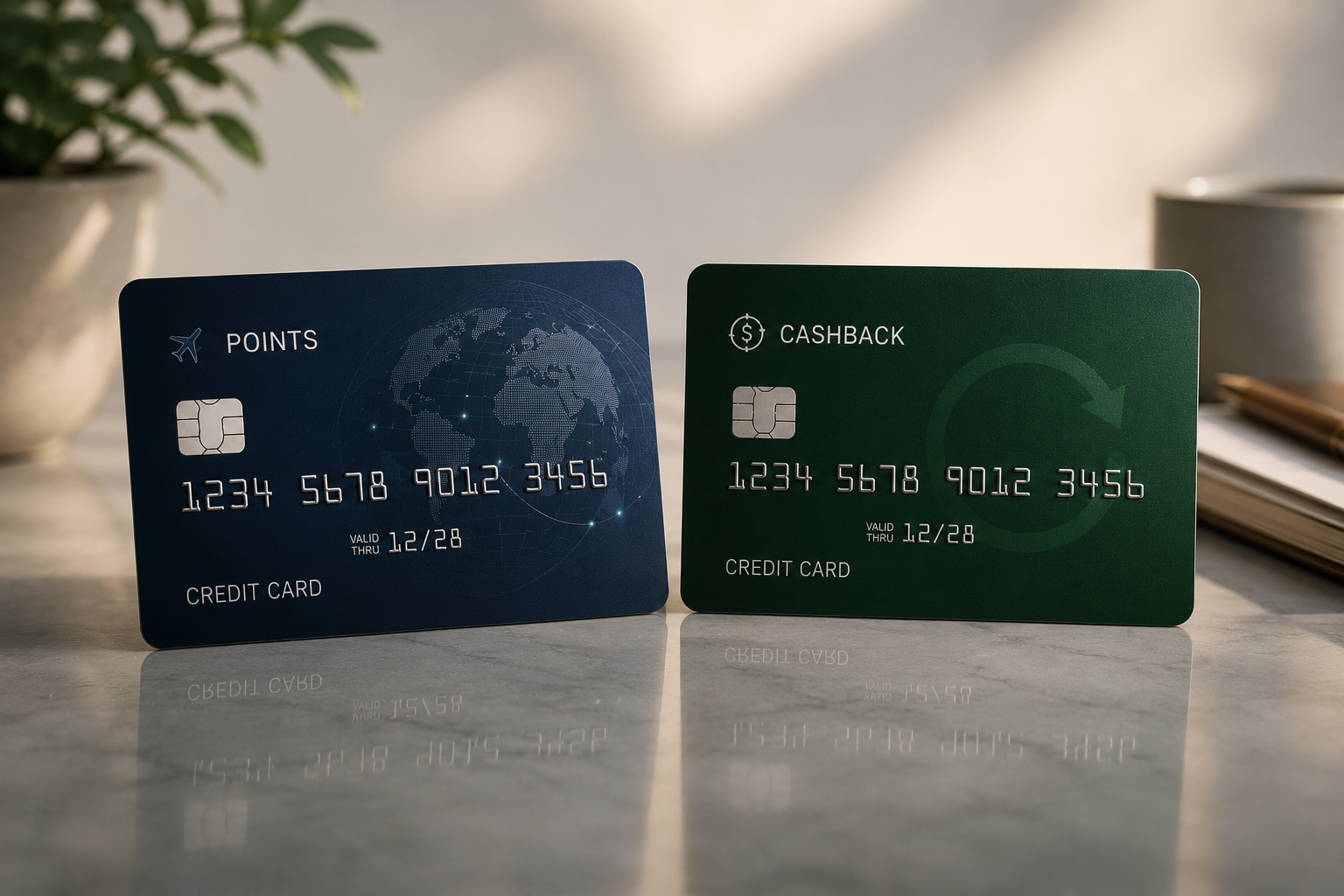
Cashback vs. Points: Which Fits Your Spending?
Cash back is easier to value; points can be more rewarding when you redeem them strategically. Here is how to compare them without relying on hype.
Published May 30, 2026 · Updated August 6, 2026 · Product details last verified August 12, 2026
Affiliate disclosure
NavoFin may earn a commission if you apply for a product through a link on this page. The issuer pays the commission, not you. Read our full disclosure.
First: rewards do not offset revolving interest
This comparison assumes you pay the statement balance in full. When a balance is carried, the interest charged can easily exceed the rewards earned. In that situation, a lower-rate product and a repayment plan usually matter more than choosing cash back or points.
Why cash back is easier
Cash back has a transparent unit of value: $1 is $1. It is easier to compare cards, easier to budget around, and less exposed to changes in award charts or redemption rules.
A no-fee card earning 2% in categories where you spend $12,000 per year would return about $240 in those categories, assuming all transactions qualify and no cap changes the rate.
Why points can win
Points can produce more value when:
- the card has a high earn rate in your largest categories;
- you transfer or redeem points through a program you understand;
- award availability fits your actual travel plans; and
- the incremental value comfortably exceeds the card's annual fee.
Points do not have one guaranteed cash value. The same balance may be worth substantially different amounts depending on the program and redemption.
Scenario A: simplicity favours cash back
Assume a person spends $500 a month in selected 2% categories and $1,000 a month elsewhere on a card that earns 0.5% elsewhere.
- Selected categories: $6,000 × 2% = $120
- Other purchases: $12,000 × 0.5% = $60
- Approximate annual cash back: $180, before any welcome offer
For someone who does not want to learn an airline program, that predictable return may be preferable even if a carefully optimized points card could potentially produce more.
Scenario B: points may justify a fee
Assume a card earns 5 points per dollar on $1,200 of eligible monthly food and grocery spending, all within the cap. That is 72,000 points per year from those purchases. The value depends entirely on how the points are redeemed. At an illustrative value of 1 cent each, that is $720; at 1.5 cents, it is $1,080. Subtract the annual fee and compare the result with the rewards the same spending would earn on a realistic no-fee card.
Those point values are examples, not guaranteed rates.
Decision rule
Choose cash back when you value certainty, simple redemptions and low ongoing effort. Compare points when you travel enough to use the program, will redeem strategically and can demonstrate a higher net value after fees.
Always verify current earn rates, category definitions, caps and redemption rules with the issuer before applying.
Sources and verification
Product information verified August 12, 2026. Promotional eligibility, expiry dates, fees and approval remain subject to the issuer's current terms and underwriting.
About the author
Caleb Larocque
Caleb Larocque is the founder of NavoFin, where he researches and compares Canadian credit cards using issuer-published rates, fees and eligibility requirements.
Spotted an error or an out-of-date rate? Email help@navofin.ca and it will be corrected, with the change reflected in this article's updated date.